
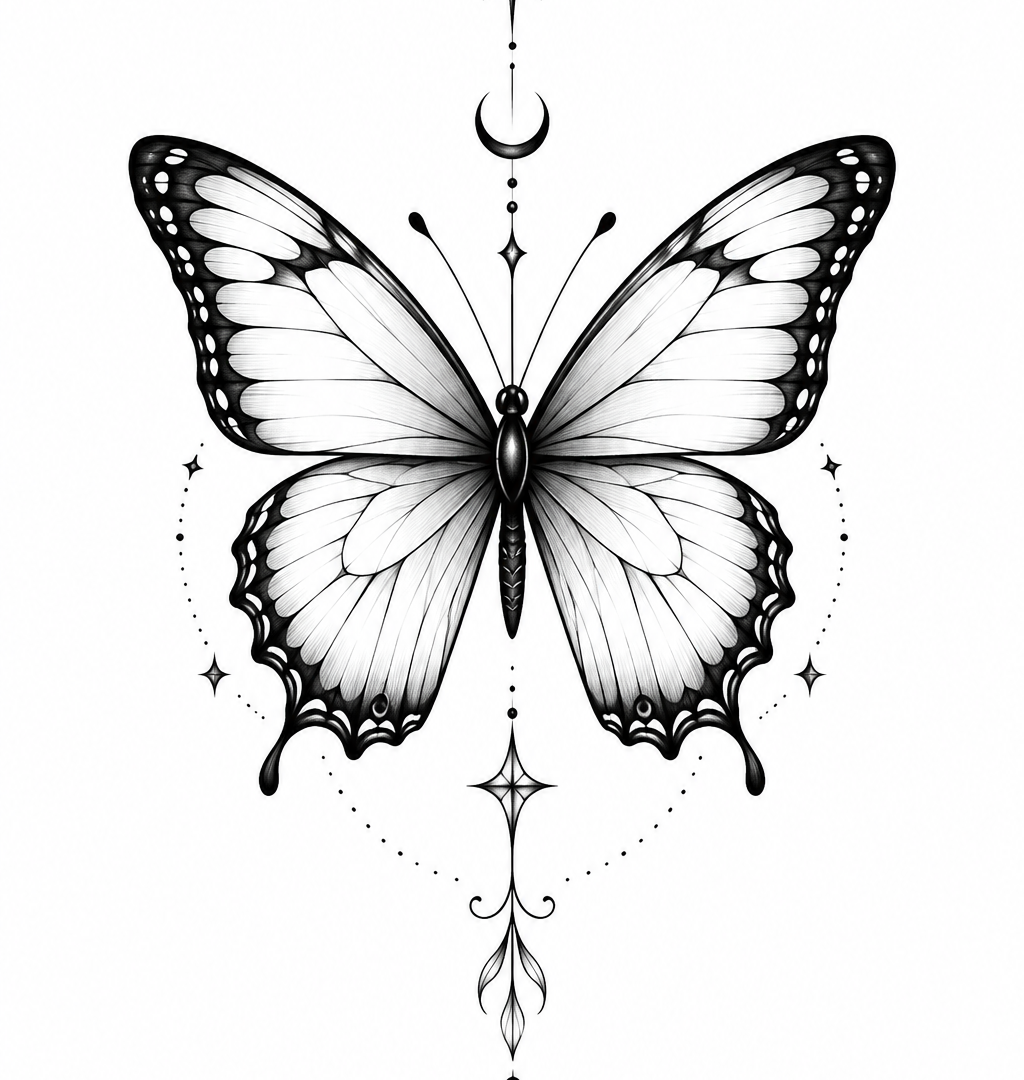
Few tattoos are as universally loved as the butterfly. It is delicate yet bold, deeply symbolic yet endlessly customizable, and it suits nearly every style, size, and placement. A butterfly can be a whisper of fine line behind the ear or a sweeping, colorful centerpiece across the back. That range is exactly why it remains one of the most requested tattoos in the world, year after year.
But a butterfly tattoo is rarely just decoration. Across thousands of years and many different cultures, the butterfly has stood for transformation, the soul, freedom, love, and rebirth. This guide covers everything you need to know before choosing yours: what butterfly tattoos mean, the meanings behind each color, the best design ideas and placements, how much they hurt, what they cost, the cultural history behind them, and the mistakes to avoid. Whether this is your first tattoo or your fifteenth, you will leave knowing exactly what you want and why.
Table of Contents
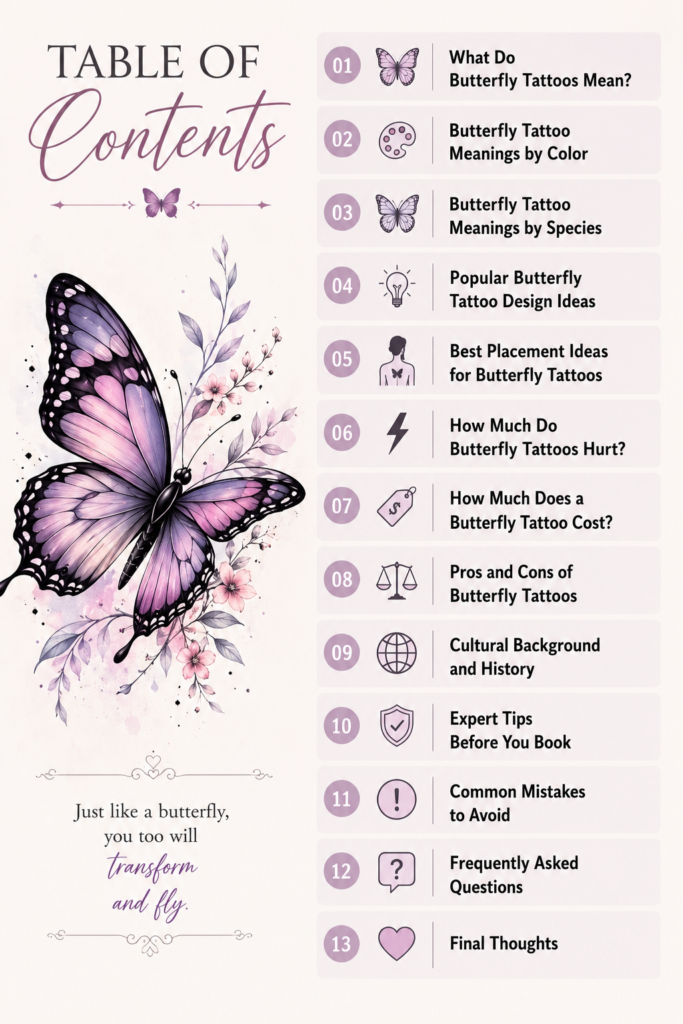
- What Do Butterfly Tattoos Mean?
- Butterfly Tattoo Meanings by Color
- Butterfly Tattoo Meanings by Species
- Popular Butterfly Tattoo Design Ideas
- Best Placement Ideas for Butterfly Tattoos
- How Much Do Butterfly Tattoos Hurt?
- How Much Does a Butterfly Tattoo Cost?
- Pros and Cons of Butterfly Tattoos
- Cultural Background and History
- Expert Tips Before You Book
- Common Mistakes to Avoid
- Frequently Asked Questions
- Final Thoughts
What Do Butterfly Tattoos Mean?
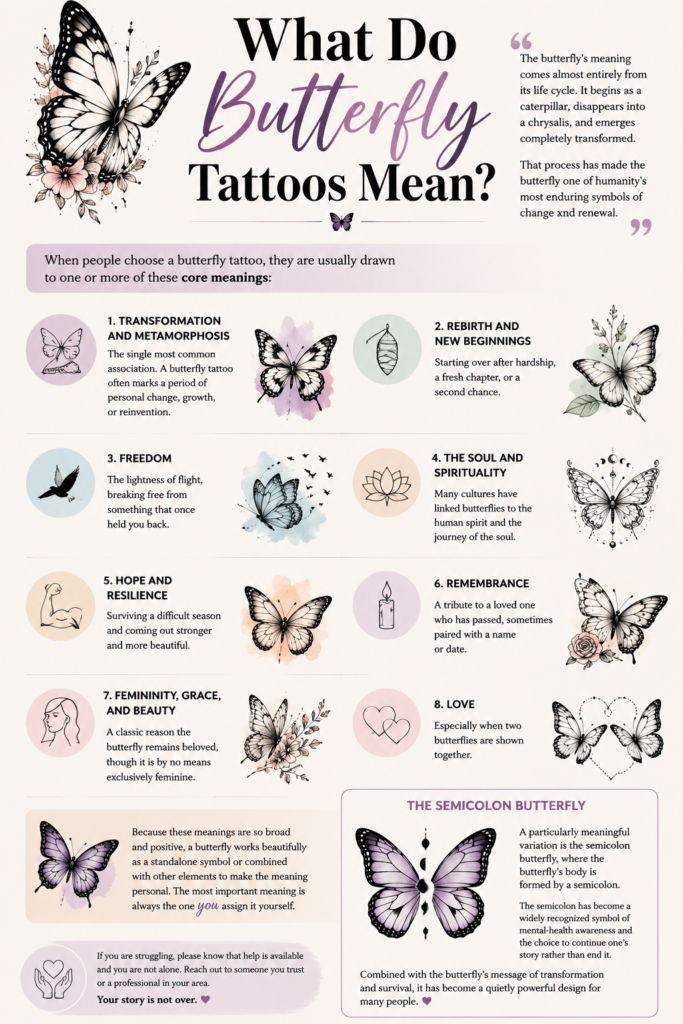
The butterfly’s meaning comes almost entirely from its life cycle. It begins as a caterpillar, disappears into a chrysalis, and emerges completely transformed. That process has made the butterfly one of humanity’s most enduring symbols of change and renewal. When people choose a butterfly tattoo, they are usually drawn to one or more of these core meanings:
- Transformation and metamorphosis — the single most common association. A butterfly tattoo often marks a period of personal change, growth, or reinvention.
- Rebirth and new beginnings — starting over after hardship, a fresh chapter, or a second chance.
- Freedom — the lightness of flight, breaking free from something that once held you back.
- The soul and spirituality — many cultures have linked butterflies to the human spirit and the journey of the soul.
- Hope and resilience — surviving a difficult season and coming out stronger and more beautiful.
- Remembrance — a tribute to a loved one who has passed, sometimes paired with a name or date.
- Femininity, grace, and beauty — a classic reason the butterfly remains beloved, though it is by no means exclusively feminine.
- Love — especially when two butterflies are shown together.
Because these meanings are so broad and positive, a butterfly works beautifully as a standalone symbol or combined with other elements to make the meaning personal. The most important meaning is always the one you assign it yourself.
The semicolon butterfly
A particularly meaningful variation is the semicolon butterfly, where the butterfly’s body is formed by a semicolon. The semicolon has become a widely recognized symbol of mental-health awareness and the choice to continue one’s story rather than end it. Combined with the butterfly’s message of transformation and survival, it has become a quietly powerful design for many people. (See the note at the end of this article regarding support resources.)
Butterfly Tattoo Meanings by Color
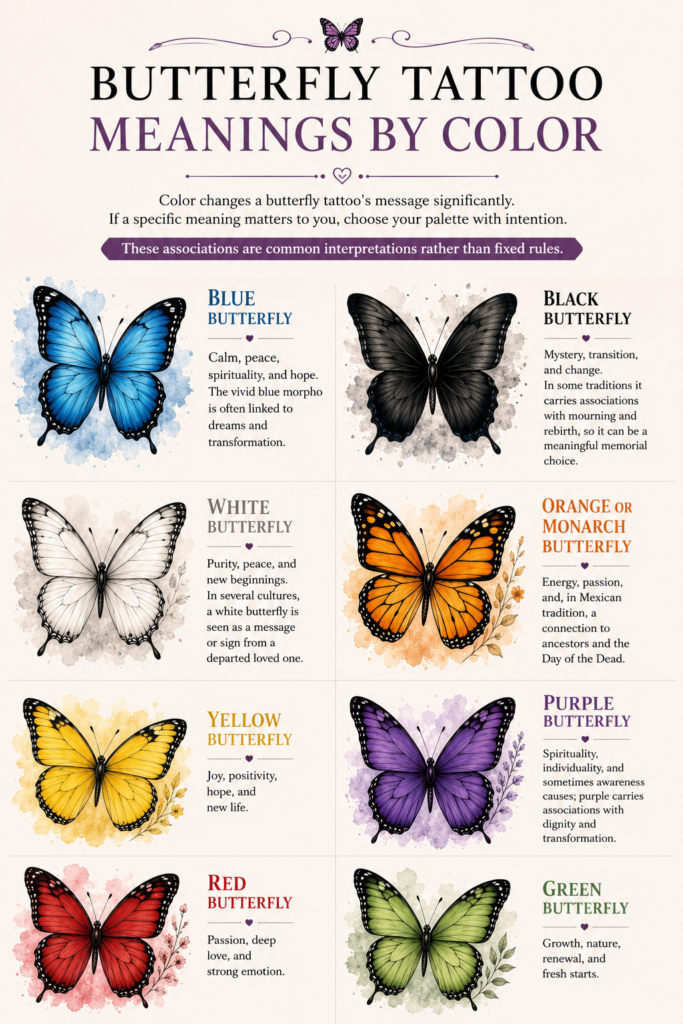
Color changes a butterfly tattoo’s message significantly. If a specific meaning matters to you, choose your palette with intention. These associations are common interpretations rather than fixed rules.
- Blue butterfly — calm, peace, spirituality, and hope. The vivid blue morpho is often linked to dreams and transformation.
- Black butterfly — mystery, transition, and change. In some traditions it carries associations with mourning and rebirth, so it can be a meaningful memorial choice.
- White butterfly — purity, peace, and new beginnings. In several cultures, a white butterfly is seen as a message or sign from a departed loved one.
- Orange or monarch butterfly — energy, passion, and, in Mexican tradition, a connection to ancestors and the Day of the Dead.
- Yellow butterfly — joy, positivity, hope, and new life.
- Purple butterfly — spirituality, individuality, and sometimes awareness causes; purple carries associations with dignity and transformation.
- Red butterfly — passion, deep love, and strong emotion.
- Green butterfly — growth, nature, renewal, and fresh starts.
If you love color but worry about longevity, talk to your artist. Bold, well-saturated color from a skilled hand can last beautifully, but some delicate pastels may need touch-ups sooner than solid black and gray.
Butterfly Tattoo Meanings by Species
Choosing a real, identifiable species can add another layer of meaning and make your tattoo more distinctive than a generic shape.
- Monarch — the famous orange-and-black migrator. Associated with ancestors and returning souls in Mexican tradition, and with resilience because of its extraordinary migration.
- Blue morpho — the striking iridescent blue butterfly, often chosen for dreams, spirituality, and transformation.
- Swallowtail — elegant, large-winged, and graceful; a popular choice for realism and traditional styles.
- Luna moth — technically a moth, but frequently requested for its ethereal pale-green wings and associations with intuition, the moon, and rebirth.
- Painted lady or common butterflies — versatile shapes that adapt well to any style when a specific species is not the point.
Are Butterfly Tattoos Meaningful or Too Common?
A common worry, especially online, is that butterfly tattoos are “basic” or overdone. It is a fair question, and the honest answer has two parts.
Yes, butterflies are extremely popular. That popularity means a plain, copied butterfly can feel generic. But popularity is not the same as meaningless. Butterflies have carried profound significance across cultures for thousands of years, and a design that is personal to you is never cliché, no matter how common the subject.
The difference between a forgettable butterfly and a striking one usually comes down to three things:
- Customization — adding a birth flower, a meaningful date, a specific species, or an unusual composition makes it yours.
- Craftsmanship — a beautifully executed piece from a skilled artist reads as art, not as a stock design.
- Intention — a butterfly chosen to mark real transformation carries weight that a trend-driven pick never will.
In short: a butterfly tattoo is only “basic” if you let it be. Put thought into the design and the artist, and it becomes deeply personal.
Popular Butterfly Tattoo Design Ideas
The butterfly is one of the most flexible subjects in tattooing. The same insect looks entirely different depending on the style. Here are the most popular directions, plus creative combinations.
Styles that suit butterflies well
- Fine line and minimalist — thin, delicate outlines. Elegant and hugely popular, though very fine detail can soften over time.
- Watercolor — soft, painterly splashes of color that mimic paint bleeding across the skin. Butterflies are the signature subject of this style.
- Realism and 3D — hyper-detailed wings that look like a real butterfly has landed on the skin, sometimes with a subtle drop shadow for a lifelike effect.
- Blackwork and ornamental — solid black wings, filigree, and decorative patterning.
- Geometric and dotwork — symmetrical, mandala-inspired wings built from precise lines and dots.
- Traditional and neo-traditional — bold outlines and rich, saturated color that age exceptionally well.
Meaningful design combinations
- Half butterfly, half flower — one wing rendered as a butterfly, the other as petals or a bloom; a striking symbol of transformation and beauty.
- Butterfly and florals — paired with roses, wildflowers, or a birth flower for a softer, personal composition.
- Butterfly with a name or date — a common and touching memorial design.
- Semicolon butterfly — the mental-health awareness variation described above.
- A trail or cluster of butterflies — several small butterflies flowing up an arm, shoulder, or spine, suggesting movement and freedom.
- Matching or family butterflies — coordinating designs shared between friends, partners, or family members, sometimes in different sizes to represent each person.
- Butterfly with wings as another image — such as wings subtly formed from mountains, waves, or a loved one’s handwriting.
A practical tip: bring reference images to your consultation for direction, but let your artist adapt the design to your body and their strengths. A custom butterfly almost always looks better than a copied one, and it will be uniquely yours.
Best Placement Ideas for Butterfly Tattoos
Butterflies are naturally symmetrical, so placement matters more than usual; the design should flow with the shape of your body. Here are the most flattering and popular options.
- Shoulder and shoulder blade — a classic, forgiving canvas that shows the full wingspan beautifully.
- Forearm and inner arm — highly visible, ages well, and easy to show or cover.
- Spine — a vertical column of butterflies along the spine is a striking, elegant modern choice.
- Back — ideal for large, detailed, or colorful centerpieces.
- Wrist and ankle — perfect for small, delicate butterflies, though these thin-skinned areas are a little more sensitive.
- Behind the ear or nape of neck — subtle, small, and easy to conceal.
- Sternum and chest — dramatic and symmetrical, well suited to the butterfly’s shape.
- Ribs and hip — flattering for medium designs that follow the body’s curves.
- Thigh — a comfortable, spacious area great for larger color pieces.
- Collarbone — elegant for a small horizontal butterfly.
If workplace visibility is a concern, choose a placement you can cover with everyday clothing. Consider not just how the butterfly looks today, but how it will sit on your body as you move, and how it will age over the years.
How Much Do Butterfly Tattoos Hurt?
Pain depends far more on placement than on the butterfly design itself, and it varies from person to person based on tolerance, sleep, hydration, and the length of the session. As a general guide, areas with more muscle and fat hurt less, while thin skin over bone hurts more.
| Pain Level | Common Butterfly Placements | Why |
|---|---|---|
| Lower | Outer forearm, outer thigh, shoulder, calf | More padding, fewer nerve endings |
| Moderate | Upper back, shoulder blade, upper arm | Balanced tissue coverage |
| Higher | Sternum, ribs, spine, inner arm, collarbone | Thin skin over bone, sensitive nerves |
| Highest | Wrist, ankle, behind the ear, neck | Little padding, near bone |
Most people describe the sensation as a hot, persistent scratching rather than sharp pain. To make the experience easier: eat a proper meal beforehand, stay hydrated, sleep well the night before, avoid alcohol, wear comfortable clothing, and remember that short breaks are completely normal.
How Much Does a Butterfly Tattoo Cost?
Prices vary widely by region, artist experience, size, detail, and color, so treat these as general ranges rather than fixed figures.
- Small, simple line-work butterfly — often falls at the studio minimum, commonly around $50 to $150.
- Medium, detailed or lightly colored butterfly — roughly $150 to $450, in line with typical U.S. averages for small-to-medium tattoos.
- Large, highly detailed color or realism piece — several hundred dollars and up, sometimes over $1,000, especially for back pieces or multi-session work.
Most studios charge either a shop minimum (a base fee covering setup and sterile supplies) or an hourly rate, which in recent years has commonly run from roughly $80–$120 per hour for newer artists up to $250 or more per hour for sought-after specialists. Remember that you are paying for skill, hygiene, and design time, not just size. A well-executed butterfly you love for decades is worth far more than a cheap one you end up removing or covering.
How to Choose the Right Butterfly Tattoo for You
With so many options, it helps to narrow your choices with a simple framework. Work through these questions before your consultation:
- What does it mean to me? Start with the message: transformation, freedom, remembrance, love, or simply beauty. Your answer shapes color, species, and any added elements.
- How big do I want it? Small and subtle, medium and detailed, or a large statement piece? Be realistic; intricate detail needs size to survive over time.
- Where will it live on my body? Consider visibility for work, comfort during the session, and how well the area ages. Match the placement to the design’s shape.
- Color or black and gray? Color adds vibrancy but may fade faster; black and gray tends to age most gracefully.
- What style speaks to me? Fine line, watercolor, realism, geometric, or traditional each tell the story differently.
- Which artist should apply it? Once you know the style, find an artist whose healed portfolio proves they excel at it, especially the clean lines and symmetry a butterfly demands.
Answering these in order turns a vague idea into a clear brief you can hand to your artist, which almost always produces a better result.
Butterfly Tattoo Aftercare Essentials
A great butterfly tattoo can be ruined by poor healing, so aftercare matters as much as the design. Your artist will give you specific instructions for the products and method they recommend; follow theirs first, and use this as a general overview.
- Keep the initial bandage on for the time your artist specifies.
- Wash gently with clean hands and a mild, fragrance-free soap, then pat dry with a clean paper towel.
- Moisturize lightly with the product your artist recommends, applying a thin layer so the skin can breathe.
- Avoid soaking the tattoo: no swimming, baths, or hot tubs while it heals.
- Protect it from the sun. UV exposure is the biggest cause of fading; once healed, sunscreen keeps colors and fine lines sharp for years.
- Do not pick or scratch as it flakes and itches; disturbing it can pull out ink and cause patchiness.
- Watch for problems. Some redness and tenderness is normal, but spreading redness, pus, or fever warrants a call to a healthcare professional.
Fine-line and delicate color butterflies are especially sensitive during healing, so disciplined aftercare directly protects the detail you paid for.
Pros and Cons of Butterfly Tattoos
Pros
- Rich, positive, and highly personal symbolism.
- Extremely versatile in size, style, color, and placement.
- Universally admired and timeless in appeal.
- Works beautifully as a small first tattoo or a large statement piece.
- Combines easily with flowers, names, dates, and other elements.
Cons
- Very popular, so a generic design may feel less unique unless customized.
- Fine detail and symmetry are technically demanding; they require a skilled artist.
- Delicate color and thin lines can fade or soften over time.
- Like all tattoos, it is permanent, and removal is slow and costly.
- Symmetrical designs make any imperfection more noticeable, so artist choice is critical.
Cultural Background and History
The butterfly is one of the most widespread symbols in human culture, and remarkably, many societies arrived at similar meanings independently. That recurrence is a testament to how naturally the insect’s transformation lends itself to spiritual interpretation. The following reflects widely documented cultural associations.
- Ancient Greece — the Greek word psyche meant both “butterfly” and “soul.” The mythological figure Psyche, a mortal woman who married the god Eros, was often depicted with butterfly wings. The Greeks watched butterflies emerge from what looked like a lifeless husk and connected it to the soul surviving death.
- China — butterflies are associated with love, joy, and longevity. A pair of butterflies represents marital happiness and lasting affection, a common motif in art and wedding decoration. The classic legend of the Butterfly Lovers (Liang Shanbo and Zhu Yingtai) tells of two lovers who become butterflies, and the philosopher Zhuangzi’s famous “butterfly dream” reflects on the nature of reality.
- Japan — butterflies symbolize the soul, particularly of women, along with happiness and marital bliss when shown as a pair. They also appear in poetry as a symbol of life’s fleeting beauty, connected to the aesthetic idea of mono no aware, a gentle awareness of impermanence.
- Aztec and Mesoamerican cultures — butterflies were linked to fire, the sun, and the spirits of fallen warriors. The goddess Itzpapalotl, whose name means “Obsidian Butterfly,” was an important deity depicted with butterfly imagery.
- Mexico and the Day of the Dead — monarch butterflies migrate to the mountains of Michoacán and typically arrive around the beginning of November, coinciding with Día de los Muertos. The Purépecha and Mazahua peoples have long held that the monarchs carry the returning spirits of ancestors, a belief that predates the Spanish conquest.
- Indigenous North America — among the Hopi, butterfly dances are associated with young women, growth, and cultural tradition, and some other nations connect butterflies with renewal and healing.
- Christianity — the butterfly’s emergence from the chrysalis has long been read as a symbol of resurrection.
Because some of these traditions carry sacred or specific cultural meaning, approach heritage-rooted designs, especially those from a culture that is not your own, with genuine respect and research. When in doubt, ask a knowledgeable artist or a member of that community.
Expert Tips Before You Book
- Don’t go too small with too much detail. Fine wing patterns need room to breathe. A tattoo that is too tiny will blur into a smudge as it ages. When in doubt, size up slightly.
- Choose your artist for symmetry and clean lines. Butterflies are symmetrical, so even small imperfections show. Review healed work in the artist’s portfolio, not just fresh photos.
- Match the style to your placement. Delicate fine line suits flatter areas; flowing color works well on the arm, back, or thigh.
- Think about color longevity. Solid black and gray generally age most gracefully. If you want color, choose a skilled color artist and commit to sun protection.
- Plan the flow. For a spine or arm piece, discuss how the butterfly or cluster will follow your body’s lines before the needle touches skin.
- Personalize it. Adding a birth flower, date, or subtle detail turns a common design into something meaningful and unique to you.
- Follow aftercare exactly. Healing is where a great tattoo is won or lost; follow your artist’s instructions and general dermatological guidance.
Common Mistakes to Avoid
- Choosing the artist by price alone. The cheapest quote is rarely the best value on permanent, symmetrical work.
- Copying an exact design from social media. Use references for inspiration, then create something custom.
- Going too small for the detail level. Intricate wings shrunk down will lose definition over the years.
- Ignoring symmetry and placement flow. A butterfly that fights the shape of your body looks awkward no matter how well it is drawn.
- Picking a trend over a meaning. A design tied to something lasting rarely goes out of style.
- Underestimating color fading. Pastels and thin lines may need touch-ups; plan for that reality.
- Skipping aftercare. Neglecting healing causes fading, patchiness, and infection risk.
- Forgetting cultural weight. If your design draws on a specific tradition, understand it first.
Frequently Asked Questions
What does a butterfly tattoo mean? A butterfly tattoo most commonly symbolizes transformation, rebirth, freedom, and the soul. Many people choose one to mark personal growth, a fresh start, resilience after hardship, or in memory of a loved one.
Are butterfly tattoos still in style? Yes. Butterfly tattoos are a timeless classic that has stayed consistently popular. Modern styles like fine line, watercolor, and geometric keep the design feeling fresh, and personal touches make it unique to you.
What does a black butterfly tattoo mean? A black butterfly commonly represents mystery, transition, and change. In some traditions it carries associations with mourning and rebirth, which makes it a meaningful memorial choice.
What does a blue butterfly tattoo mean? A blue butterfly is often linked to calm, peace, hope, and spirituality. The vivid blue morpho is especially associated with dreams and transformation.
What does the semicolon butterfly tattoo mean? It combines the butterfly’s meaning of transformation and survival with the semicolon, a widely recognized symbol of mental-health awareness and choosing to continue one’s story.
Where is the best place for a butterfly tattoo? Popular, flattering placements include the shoulder, forearm, spine, back, wrist, ankle, and behind the ear. The best spot depends on the size you want, your pain tolerance, and how visible you would like it to be.
Do butterfly tattoos hurt? Pain depends mainly on placement. Fleshier areas like the outer forearm and thigh are more comfortable, while thin-skinned areas like the wrist, ankle, ribs, and sternum are more sensitive. Most people find it very manageable.
Are butterfly tattoos only for women? No. While they are popular among women, butterflies carry universal meanings of transformation, freedom, and the soul, and suit anyone. Styles like blackwork, realism, and traditional give the design a bolder feel.
How much does a butterfly tattoo cost? A small, simple butterfly often costs the studio minimum, commonly around $50 to $150. Medium detailed or colored pieces typically run $150 to $450, and large, intricate color work can cost several hundred dollars or more.
Do fine-line butterfly tattoos fade? Fine-line and delicate color tattoos can soften over time, especially on hands, feet, and sun-exposed areas. Choosing a skilled artist, protecting the tattoo from the sun, and occasional touch-ups help keep it sharp.
Which butterfly means a new beginning? Most butterflies symbolize new beginnings because of their metamorphosis, but white and yellow butterflies are especially associated with fresh starts, purity, and new life. A monarch or blue morpho can also represent renewal and change.
Do butterfly tattoos have a bad or negative meaning? Not inherently. Butterfly tattoos are overwhelmingly positive, standing for transformation, hope, and the soul. In some cultures a butterfly relates to mourning, but even then it usually represents rebirth and remembrance rather than anything negative.
What does a butterfly tattoo mean on a woman? The meaning is the same as for anyone: transformation, freedom, beauty, and the soul. For many women it also represents personal growth, resilience, or femininity, but there is no gender-specific meaning; a butterfly means what the wearer chooses.
How long does a butterfly tattoo take? A small, simple butterfly can take under an hour, while a detailed medium piece may take two to four hours. Large color or realism designs can require multiple sessions.
Note: this article mentions the semicolon symbol and mental health as part of explaining tattoo meanings. If you are personally struggling, please know that support is available, and I’m glad to help you find appropriate resources.
Final Thoughts
A butterfly tattoo endures because it means something. It captures transformation, hope, freedom, and the resilience to emerge from a hard season more beautiful than before, a message that has resonated across Greek, Chinese, Japanese, Mesoamerican, and countless other cultures for thousands of years.
That same versatility is what makes it perfect for nearly anyone. It can be a tiny, private symbol behind the ear or a sweeping, colorful centerpiece across the back. To get it right, choose a design that means something to you, an artist whose healed work you admire, and a placement you have thought through. Do that, and your butterfly will be a piece you are proud to wear for life.
You Might Also Like
Playing Card Tattoos: Meanings, Best Designs, and Ideas
Playing card tattoos sit at the crossroads of luck, risk, fate, and rebellion. A single ace can say “I make…
Read More