
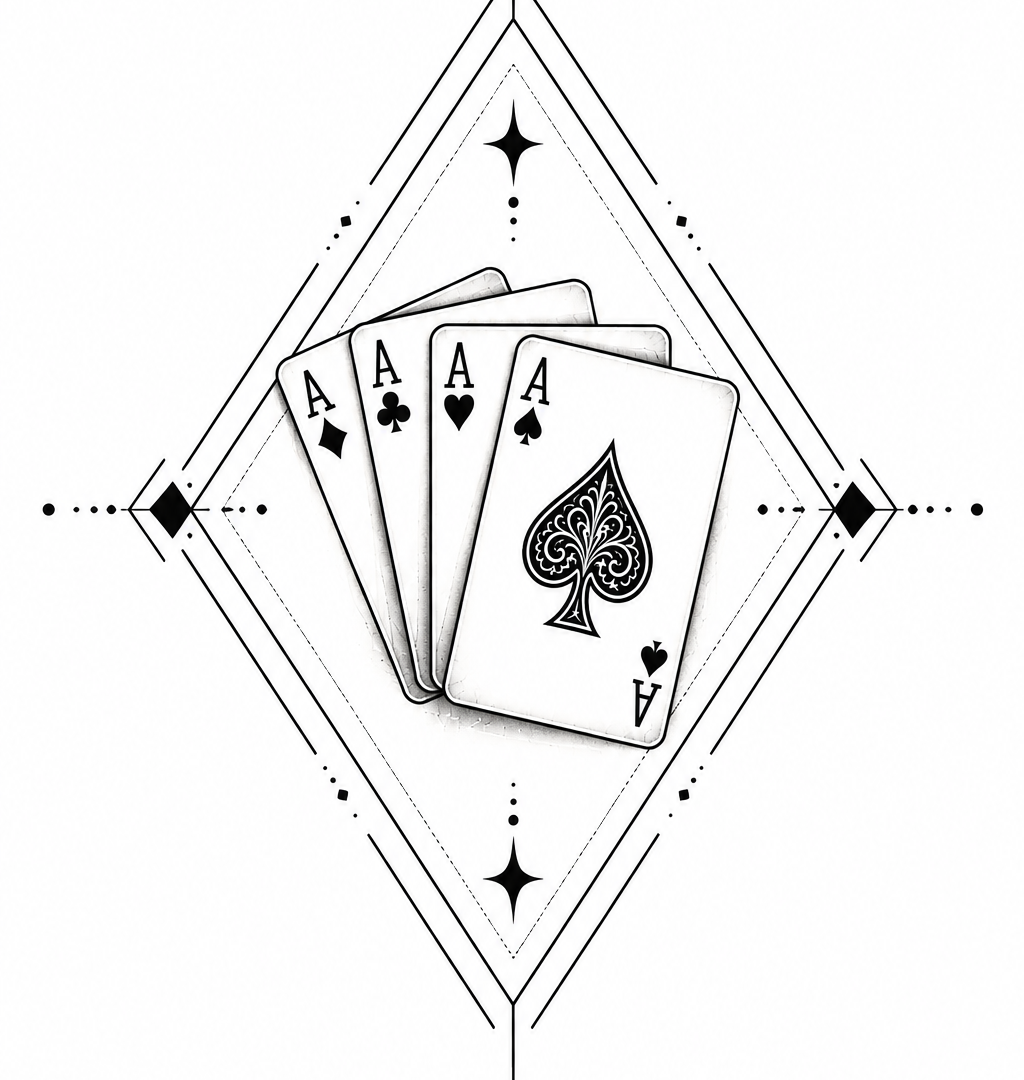
Playing card tattoos sit at the crossroads of luck, risk, fate, and rebellion. A single ace can say “I make my own luck,” while a scattered poker hand can speak to living life on your own terms. Few motifs carry as much layered history: from medieval European decks and English tax stamps to Wild West saloons and the jungles of Vietnam, the humble playing card has gathered centuries of meaning that a good tattoo can tap into.
This guide covers everything you need to know before choosing one. We will break down what playing card tattoos mean, the symbolism of each suit, the stories behind iconic designs like the ace of spades and the dead man’s hand, the best styles and placements, how much they hurt and cost, the real history behind the imagery, and the mistakes to avoid. Whether you are a poker player, a risk-taker, or simply drawn to the striking graphics, you will leave knowing exactly what your ink could say.
Table of Contents
- What Do Playing Card Tattoos Mean?
- Playing Card Suit Meanings
- Iconic Playing Card Tattoo Designs and Their Meanings
- Popular Playing Card Tattoo Styles and Ideas
- Best Placement Ideas
- How Much Do Playing Card Tattoos Hurt?
- How Much Does a Playing Card Tattoo Cost?
- Pros and Cons of Playing Card Tattoos
- Cultural Background and History
- Expert Tips Before You Book
- Common Mistakes to Avoid
- Frequently Asked Questions
- Final Thoughts
What Do Playing Card Tattoos Mean?
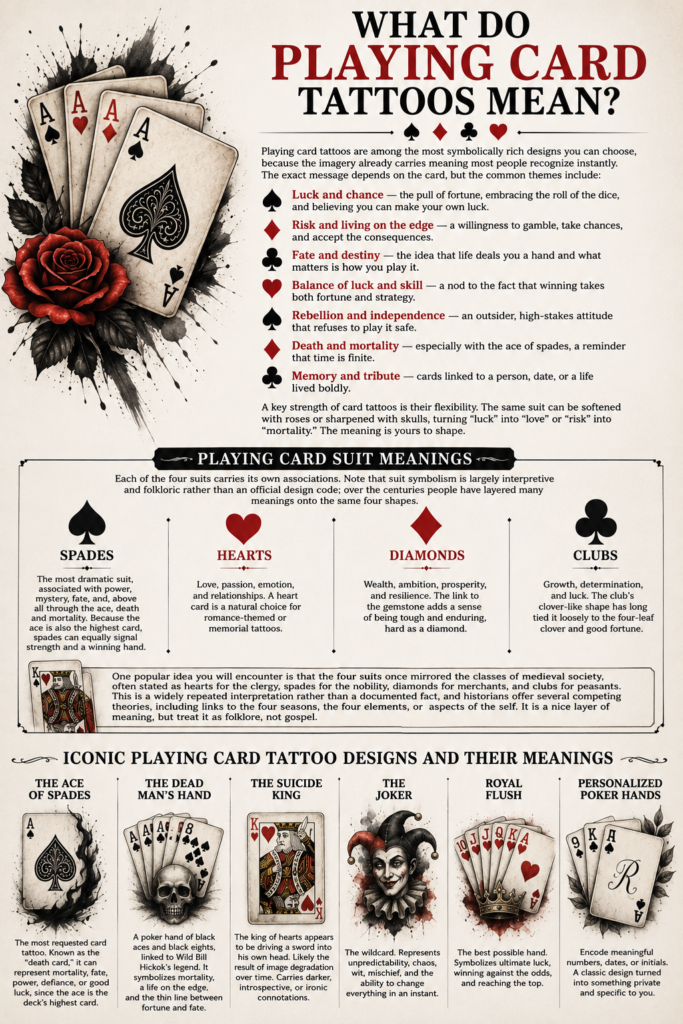
Playing card tattoos are among the most symbolically rich designs you can choose, because the imagery already carries meaning most people recognize instantly. The exact message depends on the card, but the common themes include:
- Luck and chance — the pull of fortune, embracing the roll of the dice, and believing you can make your own luck.
- Risk and living on the edge — a willingness to gamble, take chances, and accept the consequences.
- Fate and destiny — the idea that life deals you a hand and what matters is how you play it.
- Balance of luck and skill — a nod to the fact that winning takes both fortune and strategy.
- Rebellion and independence — an outsider, high-stakes attitude that refuses to play it safe.
- Death and mortality — especially with the ace of spades, a reminder that time is finite.
- Memory and tribute — cards linked to a person, date, or a life lived boldly.
A key strength of card tattoos is their flexibility. The same suit can be softened with roses or sharpened with skulls, turning “luck” into “love” or “risk” into “mortality.” The meaning is yours to shape.
Playing Card Suit Meanings
Each of the four suits carries its own associations. Note that suit symbolism is largely interpretive and folkloric rather than an official design code; over the centuries people have layered many meanings onto the same four shapes.
- Spades — the most dramatic suit, associated with power, mystery, fate, and, above all through the ace, death and mortality. Because the ace is also the highest card, spades can equally signal strength and a winning hand.
- Hearts — love, passion, emotion, and relationships. A heart card is a natural choice for romance-themed or memorial tattoos.
- Diamonds — wealth, ambition, prosperity, and resilience. The link to the gemstone adds a sense of being tough and enduring, hard as a diamond.
- Clubs — growth, determination, and luck. The club’s clover-like shape has long tied it loosely to the four-leaf clover and good fortune.
One popular idea you will encounter is that the four suits once mirrored the classes of medieval society, often stated as hearts for the clergy, spades for the nobility, diamonds for merchants, and clubs for peasants. This is a widely repeated interpretation rather than a documented fact, and historians offer several competing theories, including links to the four seasons, the four elements, or aspects of the self. It is a nice layer of meaning, but treat it as folklore, not gospel.
Iconic Playing Card Tattoo Designs and Their Meanings
Certain card tattoos have become icons in their own right, each with a story worth knowing before you commit.
The Ace of Spades
The ace of spades is the most requested playing card tattoo, and for good reason: it is loaded with meaning. It is widely known as the “death card,” a reputation built from several sources over centuries. Historically it was the most ornate card in the deck because, under an English stamp duty introduced in the early 1700s, it often carried the tax mark, and forging that stamp was a serious crime. It later became a symbol of death in wartime, most famously during the Vietnam War, where American soldiers used ace of spades cards for psychological effect. As a tattoo it can represent mortality, fate, power, defiance, or simply good luck, since the ace is the deck’s highest card.
The Dead Man’s Hand
The dead man’s hand refers to a poker hand of black aces and black eights. According to Old West legend, it was the hand held by the gunfighter and lawman “Wild Bill” Hickok when he was shot and killed in Deadwood in 1876. It is worth being honest about the history: no contemporaneous record confirms the exact cards, and the modern version of the story was largely popularized by a book published in 1926. As a tattoo, the dead man’s hand symbolizes mortality, a life lived on the edge, going out on your own terms, and the thin line between fortune and fate.
The Suicide King
The king of hearts is nicknamed the “suicide king” because in the standard design he appears to be driving a sword into or behind his own head. The most commonly cited explanation is that the image degraded over generations of hand-copying: what may once have been an axe or a differently positioned weapon gradually turned into the self-stabbing pose we see today. As a tattoo it carries darker, introspective, or ironic connotations and is often chosen for its striking, slightly unsettling look. (See the note at the end of this article regarding support resources.)
The Joker
The joker is the wildcard, literally. As a tattoo it represents unpredictability, chaos, wit, mischief, and the ability to change everything in an instant. It suits people who embrace their unconventional side or who like the idea of being the unexpected element in any situation.
Full Poker Hands and Royal Flush
A royal flush, the best possible hand, symbolizes ultimate luck, winning against the odds, and reaching the top. A personalized poker hand can encode meaningful numbers, dates, or initials, turning a classic design into something private and specific to you.
Popular Playing Card Tattoo Styles and Ideas
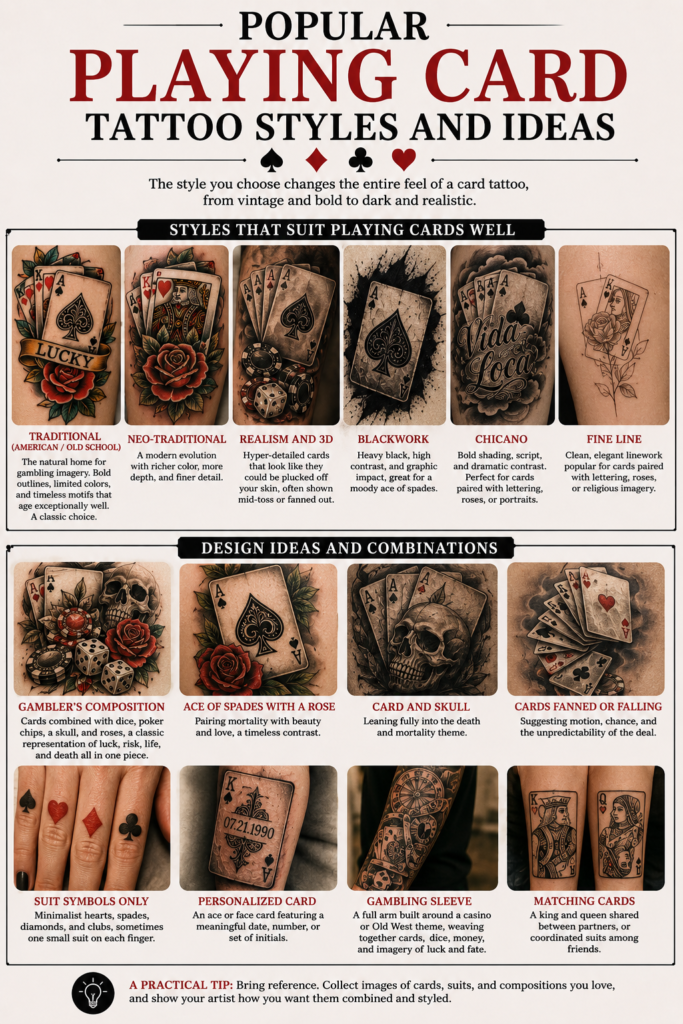
The style you choose changes the entire feel of a card tattoo, from vintage and bold to dark and realistic.
Styles that suit playing cards well
- Traditional (American / Old School) — the natural home for gambling imagery. Bold outlines, limited colors, and timeless motifs that age exceptionally well. A classic choice.
- Neo-traditional — a modern evolution with richer color, more depth, and finer detail.
- Realism and 3D — hyper-detailed cards that look like they could be plucked off your skin, often shown mid-toss or fanned out.
- Blackwork — heavy black, high contrast, and graphic impact, great for a moody ace of spades.
- Chicano and fine line — clean, elegant linework popular for cards paired with lettering, roses, or religious imagery.
Design ideas and combinations
- Gambler’s composition — cards combined with dice, poker chips, a skull, and roses, a classic representation of luck, risk, life, and death all in one piece.
- Ace of spades with a rose — pairing mortality with beauty and love, a timeless contrast.
- Card and skull — leaning fully into the death and mortality theme.
- Cards fanned or falling — suggesting motion, chance, and the unpredictability of the deal.
- Suit symbols only — minimalist hearts, spades, diamonds, and clubs, sometimes one small suit on each finger.
- Personalized card — an ace or face card featuring a meaningful date, number, or set of initials.
- Gambling sleeve — a full arm built around a casino or Old West theme, weaving together cards, dice, money, and imagery of luck and fate.
- Matching cards — a king and queen shared between partners, or coordinated suits among friends.
A practical tip: bring reference images for direction, but give your artist freedom to design a custom piece. A card tattoo built for your body and your story always beats a copied flash design, and it will be uniquely yours.
How to Choose the Right Playing Card Tattoo for You
With so many possibilities, a simple framework helps you land on the right design. Work through these before your consultation:
- What is the core message? Luck, risk, fate, love, mortality, or tribute? Your answer points you toward a specific card and any elements to pair with it.
- Playful or dark? Decide whether you want a lucky, high-energy feel or a moodier, mortality-themed piece. The same card can go either way with the right color and linework.
- One card or a scene? A single ace reads as clean and iconic; a gambler’s composition tells a fuller story but needs more space.
- Should it be personal? Adding a meaningful date, number, or initials transforms a common card into something unmistakably yours.
- Which style fits? Bold traditional, rich neo-traditional, gritty blackwork, or lifelike realism each change the mood entirely.
- Who should tattoo it? Once you know the style, choose an artist whose healed portfolio proves they excel at it.
Answering these in order turns a vague idea into a clear brief, which almost always produces a stronger, more personal result.
Best Placement Ideas
Playing cards are rectangular and graphic, so they work best where the shape has room to sit naturally.
- Forearm — highly visible, ages well, and ideal for a single card or a small cluster.
- Upper arm and shoulder — a forgiving canvas with space for detail or a gambler’s composition.
- Chest and back — perfect for large, dramatic pieces or full scenes.
- Calf and thigh — comfortable, spacious areas great for medium to large designs.
- Hand and fingers — bold and eye-catching, sometimes with a suit symbol per finger, though these areas fade fastest and need touch-ups.
- Ribs — dramatic for a vertical card or hand, but among the more painful spots.
- Full sleeve — the go-to for a themed gambling or casino narrative.
If workplace visibility matters, pick a placement you can cover with everyday clothing. Consider not just how it looks today, but how it will age and how often you want it on display.
How Much Do Playing Card Tattoos Hurt?
Pain depends far more on placement than on the card design itself, and it varies from person to person based on tolerance, sleep, hydration, and session length. In general, areas with more muscle and fat hurt less, while thin skin over bone hurts more.
| Pain Level | Common Card Tattoo Placements | Why |
|---|---|---|
| Lower | Outer forearm, outer thigh, shoulder, calf | More padding, fewer nerve endings |
| Moderate | Upper arm, upper back | Balanced tissue coverage |
| Higher | Ribs, chest, inner arm | Thin skin over bone, sensitive nerves |
| Highest | Hands, fingers, ankles | Little padding, near bone |
Most people describe the sensation as a hot, persistent scratching rather than sharp pain. To make the session easier: eat a proper meal beforehand, stay hydrated, sleep well the night before, avoid alcohol, wear comfortable clothing, and remember that short breaks are completely normal, especially for larger pieces.
How Much Does a Playing Card Tattoo Cost?
Prices vary widely by region, artist experience, size, color, and detail, so treat these as general ranges rather than fixed figures.
- Small single card or suit symbol — often falls at the studio minimum, commonly around $50 to $150.
- Medium detailed or colored card design — roughly $150 to $450, in line with typical U.S. averages for small-to-medium tattoos.
- Large gambler’s composition or sleeve — several hundred dollars and up, often over $1,000 and spread across multiple sessions.
Most studios charge either a shop minimum (a base fee covering setup and sterile supplies) or an hourly rate, which in recent years has commonly run from roughly $80–$120 per hour for newer artists up to $250 or more per hour for sought-after specialists. Detailed realism and full sleeves sit at the higher end because of the time and skill involved. Remember that you are paying for craftsmanship, hygiene, and design time, not just size. A well-executed card tattoo you love for decades is worth far more than a cheap one you end up fixing or removing.
Pros and Cons of Playing Card Tattoos
Pros
- Instantly recognizable, meaningful imagery with rich history.
- Highly versatile in size, style, and symbolism.
- Combines beautifully with dice, roses, skulls, lettering, and more.
- Works as a small standalone piece or an epic themed sleeve.
- Bold, graphic designs tend to age very well, especially in traditional styles.
Cons
- Some designs, like the ace of spades, are very common, so customization matters.
- Fine detail and small text on cards can blur over time if sized too small.
- Certain imagery (death cards, the suicide king) carries dark connotations you should be comfortable wearing.
- Like all tattoos, it is permanent, and removal is slow and costly.
- Hand and finger placements fade fastest and need upkeep.
Cultural Background and History
Playing cards carry centuries of history, and much of a card tattoo’s meaning is inherited from that story. The following reflects widely documented history, with the honest caveats where the record is uncertain.
The earliest ancestors of playing cards likely emerged in China around the 9th century, and card games spread westward, reaching Europe by the late 1300s. Early European decks used suits derived from Italian and Spanish traditions, cups, coins, swords, and batons, which were themselves connected to the tarot tradition. In the late 1400s, the French standardized the four suits we know today: hearts (cœurs), spades (piques), diamonds (carreaux), and clubs (trèfles). The French designs were simple, geometric, and easy to reproduce with stencils, which helped them spread across Europe and become the global standard.
A few threads are especially relevant to tattoos:
- The ornate ace of spades. In 1711, Queen Anne introduced a stamp duty on playing cards in Britain. To show the tax was paid, a mark was applied to one card, usually the ace of spades, and over time this ace became far more decorated than the rest. Forging the stamp was a serious crime. The duty was not abolished until 1960, yet the tradition of an especially elaborate ace endures to this day.
- The dead man’s hand. The legend of Wild Bill Hickok being shot in 1876 while holding black aces and eights gave rise to the term. Importantly, no contemporaneous source confirms the exact cards; the popular version was cemented by a book published in 1926, and the fifth card remains unknown. It is a powerful piece of folklore, best worn with that understanding.
- Wartime symbolism. Card suits appeared as unit markings on American helmets in World War II. During the Vietnam War, U.S. soldiers used ace of spades cards for psychological effect, reportedly believing the enemy associated the card with death. The actual impact is debated by historians, and the “death card” reputation was as much American myth-making as documented enemy belief.
- Court card lore. Traditional French decks are sometimes said to model their kings on historical figures such as Charlemagne, King David, Julius Caesar, and Alexander the Great, and the king of hearts became known as the “suicide king” through the quirks of the design. These attributions are traditional and partly legendary rather than firmly documented.
Beyond specific stories, playing cards have long attracted symbolic overlays, such as 52 cards for the weeks of the year and four suits for the seasons. These are appealing interpretations rather than proven design intentions, but they add to the deck’s mystique, and to the meaning behind a card tattoo.
Expert Tips Before You Book
- Don’t size it too small. Cards carry detail: pips, faces, and sometimes text. Give the design enough room so it stays crisp as it ages.
- Choose an artist for the style. A bold traditional ace and a photorealistic falling-card scene demand very different skill sets. Review healed work in your artist’s portfolio, not just fresh photos.
- Decide on the mood. Playful and lucky, or dark and mortal? The same card can lean either way depending on color, linework, and the elements around it.
- Personalize it. A meaningful date, number, or set of initials on a card turns a common design into something that is truly yours.
- Plan combinations carefully. Cards, dice, skulls, and roses can crowd a small space fast. Discuss composition and flow before the needle touches skin.
- Mind the connotations. Be comfortable wearing death or suicide-themed imagery long-term; these designs invite questions.
- Follow aftercare exactly. Healing is where a great tattoo is won or lost; follow your artist’s instructions and general dermatological guidance.
Common Mistakes to Avoid
- Choosing the artist by price alone. The cheapest quote is rarely the best value on permanent, detailed work.
- Copying an exact design from social media. Use references for inspiration, then create something custom.
- Sizing detailed cards too small. Faces, pips, and text blur when shrunk down too far.
- Overcrowding the composition. Cramming cards, dice, skulls, and roses into a tiny area muddies the piece.
- Ignoring the meaning. Understand the story behind the ace of spades, dead man’s hand, or suicide king before wearing it for life.
- Picking a trend over a message. A card tied to something lasting will always mean more than a passing fad.
- Neglecting aftercare. Poor healing causes fading, patchiness, and infection risk.
- Forgetting placement upkeep. Hands and fingers look great but fade fastest, so plan for touch-ups.
Frequently Asked Questions
What does a playing card tattoo mean? Playing card tattoos generally symbolize luck, chance, risk, fate, and living life on your own terms. The specific meaning depends on the card and any elements paired with it, such as dice, skulls, or roses.
What does an ace of spades tattoo mean? The ace of spades commonly represents death, fate, power, and defiance, and it is widely known as the “death card.” Because it is also the deck’s highest card, it can equally symbolize good luck and a winning hand.
What is the dead man’s hand tattoo? It depicts black aces and black eights, the hand legend says Wild Bill Hickok held when he was killed in 1876. As a tattoo it symbolizes mortality, high-stakes living, and going out on your own terms. Note that the exact cards are historical legend, not confirmed fact.
What does each card suit mean? Broadly: spades relate to power, fate, and mortality; hearts to love and emotion; diamonds to wealth and resilience; and clubs to growth, determination, and luck. These meanings are interpretive rather than official.
Are playing card tattoos good luck or bad luck? It depends on your interpretation. Aces and winning hands are often seen as symbols of luck and success, while the ace of spades and dead man’s hand carry associations with fate and death. There is no universal rule; the meaning is what you assign it.
What does a joker card tattoo mean? The joker is the wildcard, representing unpredictability, chaos, wit, mischief, and the power to change any situation in an instant.
What is the suicide king tattoo? It is the king of hearts, nicknamed the suicide king because he appears to be stabbing his own head with a sword, most likely the result of the design degrading over centuries of copying. It carries darker, introspective, or ironic meaning.
Where is the best place for a playing card tattoo? Popular placements include the forearm, upper arm, chest, back, calf, and thigh, with full sleeves ideal for themed gambling designs. The best spot depends on the size, your pain tolerance, and how visible you want it.
Do playing card tattoos hurt? Pain depends mainly on placement. Fleshier areas like the outer forearm and thigh are more comfortable, while ribs, chest, hands, and fingers are more sensitive. Most people find it very manageable.
How much does a playing card tattoo cost? A small single card often costs the studio minimum, commonly around $50 to $150. Medium detailed or colored designs typically run $150 to $450, and large gambler’s compositions or sleeves can cost several hundred dollars or more.
Note: this article discusses imagery such as the “death card” and the “suicide king” as part of explaining tattoo history and meaning. If you are personally struggling, please know that support is available, and I’m glad to help you find appropriate resources.
Final Thoughts
Playing card tattoos endure because they say so much with so little. A single ace can capture luck, fate, defiance, and mortality all at once, and a scattered poker hand can tell the story of a life lived boldly. Behind the striking graphics lies real history, from ornate tax-stamped aces to Wild West legends and wartime myth, and the best card tattoos wear that history with intention.
To get yours right, decide on the meaning and mood you want, personalize the design so it belongs to you, and choose an artist whose healed work proves they can execute the style. Do that, and your playing card tattoo will be a bold, meaningful piece you are proud to wear for life.
You Might Also Like
Butterfly Tattoos: Meanings, Best Designs, and Placement Ideas
Few tattoos are as universally loved as the butterfly. It is delicate yet bold, deeply symbolic yet endlessly customizable, and…
Read More